
Cell Cycle Analysis of Embryonic Stem Cells During Renewal and Differentiation
ES cells have the capacity to differentiate in vitro in any type of cells and obtaining “ES-like” cells from adult tissues will offer the opportunity to create patient-tailored cells to use in the therapy of many different diseases. Yet, to reach that stage we need a greater understanding of the mechanisms underlying the cell cycle of ES cells and of the processes occurring during their differentiation.
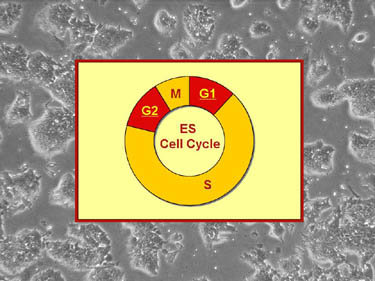
Embryonic stem (ES) cells have atypical cell cycle features including very short gap phases and short generation times. It has also been reported that, in contrast to other cell types, the levels of the APC/C substrates and other cell cycle regulators are constant along their cell cycle. Furthermore, it has been shown that the pocket proteins pRb and p107 are constantly phosphorylated and inactivated. Because in many embryonic systems differentiation and proliferation are often closely correlated, the unusual properties of the ES cell cycle may be associated with the ability to preserve the undifferentiated state.
We are now studying the regulation of Cdk and APC/C activities in murine embryonic stem cells (mESC) and how their perturbation affects pluripotency and cell cycle regulation.
We are also performing screenings to identify and characterize the molecular processes occurring during renewal and differentiation.
The studies proposed here have the potential to greatly increase our understanding of stem cell biology and to unravel the interaction between cell cycle control, differentiation and maintenance of pluripotency. This will ease the task of achieving high quality standards in the derivation of ES-like cells from adult stem cells and in the derivation of a plethora of cell types to use for treatments of many different diseases.
Collaboration
We are collaborating with In-Hyun Park , Rui Zhao, and Paul Lerou of George Daley’s lab at Children Hospital (Boston) .